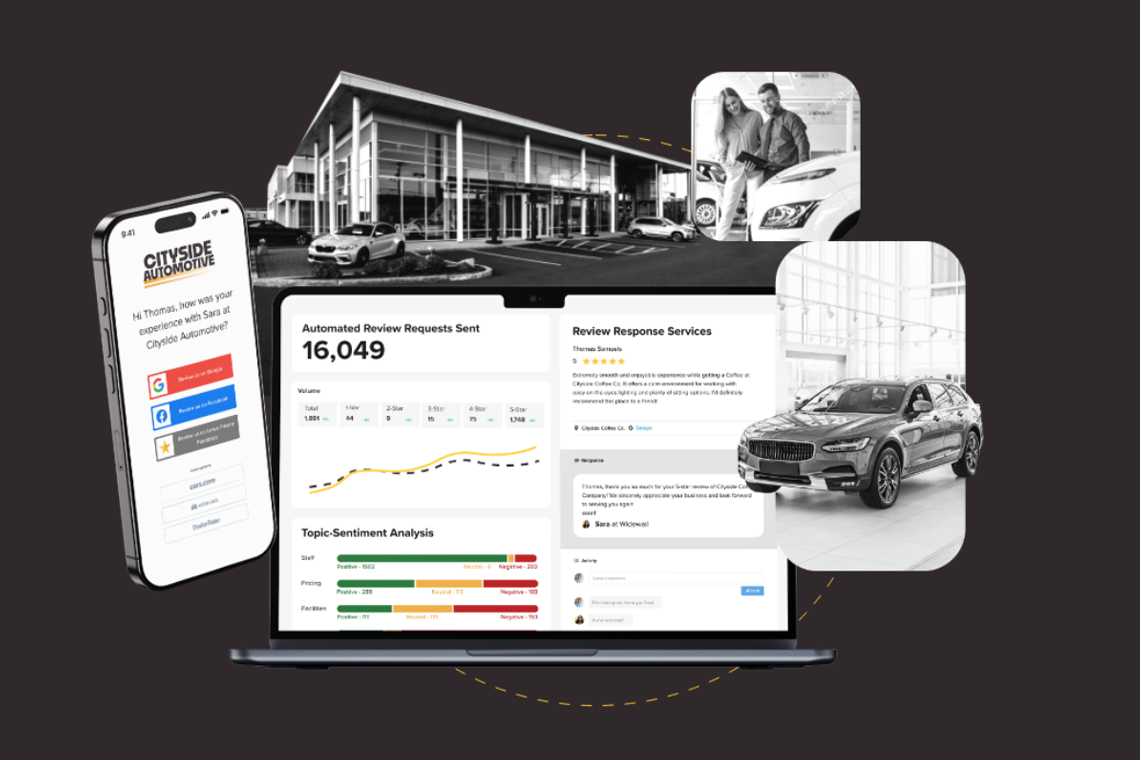
Years ago, reputation management was something only a few companies did.
Today it’s simply “table stakes,” something everyone is doing, Cuyler Owens, CEO of Widewail, said. But as Widewail works the exhibit hall at NADA 2026 this year in Las Vegas, it’s raising the stakes of successful reputation management.
Owens started in the fleet management space as a co-founder of Dealerware a decade ago and later left the auto industry to work for TrustRadius, a company that worked in reputation management and customer reviews for large B2B tech firms. Owens then joined Widewail, allowing him to use his experience and knowledge both in automotive and reputation management. “(General reputation management) is making sure customers are giving reviews and making sure those reviews are being responded to through a whole team in Burlington, Vt.,” he said. But for Widewail, reputation management is about getting ahead of the curve.
The next step is taking that information dealers learn through surveys and responses and pivoting toward the goal of interpreting that information, Owens said. It’s about using the proprietary information from all of the reviews that have been written about all 18,000 franchise dealers that use Widewail and using it to anticipate problems and direct improvements. “We have benchmarking data across these tags to see ‘how is your communication,’ and ‘how does it compare to other dealers in your area or manufacturing world?’” he said.
It looks at the staff – how is its professionalism, product knowledge, etc. – and interpreting all that knowledge, getting into what Owens calls customer intelligence. "Customer intelligence is getting outside of what has traditionally been sitting in the marketing department at dealerships and groups,” Owens said, “to going across the breadth of all operations – fixed operations, variable operations. “It’s one thing to listen to your customers, it’s another to listen and apply what you’ve learned to improve your business.”
Widewail’s platform takes, that information, tags it, classifies it, categorizes it, and benchmarks it across the industry to help dealers get better at each one of those disciplines that it’s tagging, Owens said. Any dealer that stops at Widewail’s booth at NADA, can get a scorecard printout showing how the dealer is performing across the industry based on these 27 tags or areas, whether good or bad.
The wealth of information from dealers’ customers reviews can do more than just boost reputation, it can help dealers improve operations by responding to that information. It can flag specific staff members to help a dealer improve or help train up that staffer, Owens said, saving money on turnover or training a new staffer.This is better than being a reputation “generalist” that doesn’t have the deep knowledge of the auto industry and the specific needs or dealers, he said.
Widewail can use it’s information and point out best practices where customers respond well. For example, Widewail did a study for large public group, which recently changed a policy by charging credit card fees back to its customers, Owens said.
Previously, the group would pay the 2.5% credit card fees for its customers. The study then looked at what the response of customers was to the change. The critical part was the client spent a big effort in communicating the upcoming change to its customers, preparing and training it’s team to respond and communicate to customers before it rolled out the change, Owens said. As a result, customer sentiment improved, concerns about the pricing were flat because the company spent time prepping customers for the change and answering questions and responding to concerns. Knowing that information, understanding how its customers felt and preparing them for the fee meant the client was able to collect millions of dollars in credit card fees, while keeping its customers happy.
This is how understanding and anticipating customers’ thoughts and concerns, listening to them and responding in a way that addresses their concerns does more than just charting their responses, Owens said. Finding the line between when a dealer’s customers will say, “No, I’m going somewhere else” or “Yeah, I’m OK with this, as long as a I understand and it’s explained to me,” is critical to keeping customers happy and boosting the bottom line.
“We’re helping customers find that line,” Owens said.