
Critical Shifts:
-
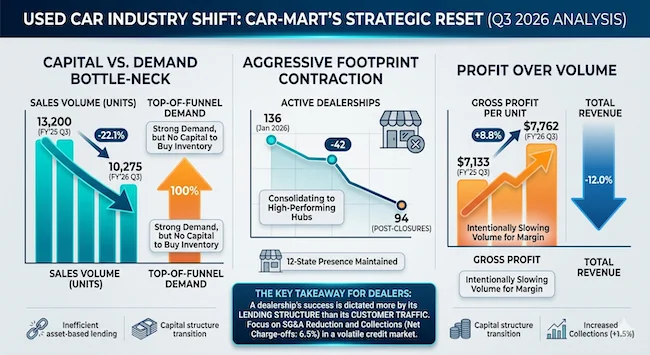
Capital Constraints Overriding Market Demand: Despite "strong top-of-funnel demand" for affordable vehicles, Car-Mart was forced to slash sales volume by 22.1% because it lacked the "origination capacity" (funding) to purchase inventory. This highlights a critical lesson: in 2026, a dealership's success is dictated more by its lending structure than its customer traffic.
-
Aggressive Footprint Contraction: The closure of 42 dealerships (one-third of its network) following 18 previous consolidations signals a pivot from broad geographic reach to "high-performing hubs." The company is moving away from an "inefficient" asset-based lending model in favor of a leaner, centralized operation that can better absorb market volatility.
-
Profitability vs. Volume Strategy: While total revenue fell 12%, Car-Mart successfully increased its gross profit per unit by 8.8% to $7,762. This suggests the company is intentionally cherry-picking higher-quality deals and focusing on margin over mass units to survive a "challenging capital transformation."
-
The Subprime "Safety" Buffer: With net charge-offs rising to 6.5%, the company is prioritizing collections (up 1.5%) and SG&A reduction (down via store closures) to protect liquidity. For independent dealers, this underscores a tightening credit environment where managing the "paper" is just as vital as moving the metal.
_________________________________________________
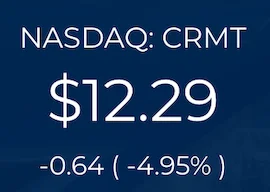
ROGERS, AR – The used car market is undergoing a massive shift as America’s Car-Mart (NASDAQ: CRMT) announces the closure of 42 dealerships, a move that highlights the growing volatility in subprime auto financing liquidity. This aggressive strategy of dealership SG&A reduction comes as the company faces a critical transition away from inefficient lending models toward more sustainable asset-backed securitization (ABS) for used car dealers. As buy-here pay-here inventory trends shift toward high-performing hubs, the industry is watching closely to see if this "shrink-to-grow" model will provide the necessary origination capacity to survive a tightening credit market in 2026.
The Capital Crunch: Why Sales Dropped 22%
While many dealers are fighting for inventory, Car-Mart’s latest quarterly report reveals a different kind of struggle. Despite "strong demand" for affordable used vehicles, the company saw a 22.1% decline in sales volume.
 CEO Doug Campbell clarified that this wasn't a lack of buyers, but a forced "moderation of capital." Essentially, the company’s previous lending structure became too restrictive, preventing them from deploying the cash necessary to buy fresh units. For the niche used car dealer, this highlights a growing trend: Access to flexible floorplan financing and securitization is becoming more important than the demand on the lot.
Strategic Retreat to "High-Performing" Hubs
The closure of these 42 stores, combined with 18 earlier consolidations, leaves Car-Mart with 94 locations. This "shrink-to-grow" strategy is designed to:
-
Streamline SG&A: The company is cutting "inefficient" overhead to protect its bottom line.
-
Boost Unit Profitability: Interestingly, even with fewer sales, Car-Mart saw gross profit per unit improve by 8.8% to $7,762.
-
Improve Collections: Total collections were actually up 1.5%, showing that while they are selling fewer cars, they are focusing on higher-quality paper.
The "New Normal" for BHPH Operations
Car-Mart’s struggle to replace its "inefficient" revolving credit line with a more modern lending structure is a case study for the industry. The company is currently working on new asset-backed securitizations (ABS) and warehouse facilities to restore its ability to buy cars.
For other operators in the used car space, the message is clear: Efficiency is the theme for 2026. Scaling too fast on high-interest debt can lead to a "origination bottleneck" where you have the customers, but not the financial flexibility to put them in cars.
Niche Perspective: The Opportunity for Independents?
As a major player like Car-Mart retreats from 42 markets, local independent dealers may find a temporary vacuum in the affordable, credit-challenged segment. However, with Car-Mart reporting a 6.5% net charge-off rate, dealers should move with caution. The subprime segment remains robust in demand but increasingly difficult to finance and collect.
Key Takeaways for Independents
-
Watch Your Debt Structure: Inefficient lending models can kill sales volume even when demand is high. If your capital is tied up, your lot stays empty.
-
Profit Over Volume: Car-Mart is proving that you can lose 22% of your sales volume but still increase your profit per unit by nearly 9%.
-
Consolidate to Survive: If a store isn't pulling its weight, 2026 is the year to consolidate operations into your highest-performing "hubs" to save on SG&A.