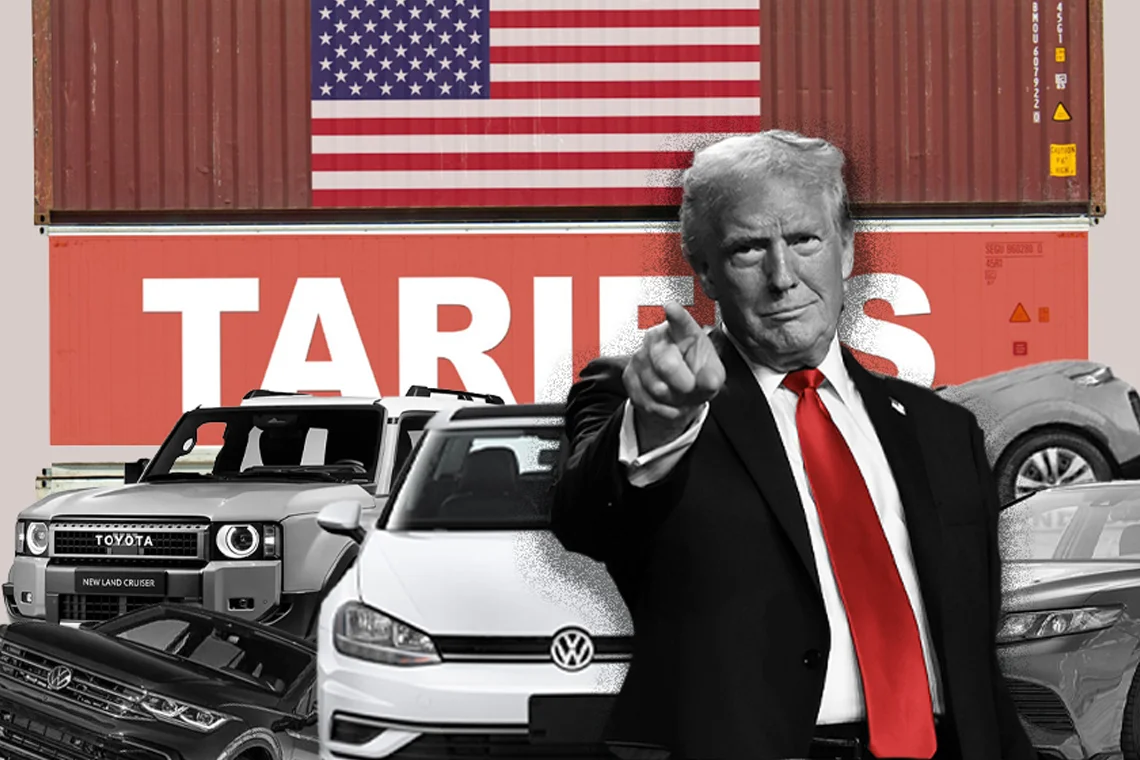
President Donald Trump announced potential new auto industry tariffs to begin in early April, on Friday Feb. 14’s executive-order signing session in the Oval Office. "Maybe around April 2," was Trump’s reply to a question when asked when auto tariffs would come into effect. "I would have done them on April 1... But we're going to do it on April 2." April 1st is the day Trump’s economics team is due to deliver reports to him outlining options for a range of imports he can slap reciprocal tariffs on, affecting every country that taxes U.S. exports.
Since Jan 20, The Trump Admin has imposed a 10% tariff on all imports from China, on top of already existing ones. The admin. announced and then delayed 25% tariffs on goods from Mexico and Canada and set a March 12 start date for 25% tariffs on all imported steel and aluminum.
The auto tariff threat puts some of the biggest brands in Japan, Germany and South Korea in Trump’s crosshairs. Imports made up around half of the US auto market in 2024. According to Global Data, About 80% of Volkswagen AG’s US sales are imported, while 65% of Hyundai-Kia’s US sales are imported. In 2023, Samsung, Volkswagen , and the IKEA Group were at the forefront of shipping Cars to the United States.
In 2023, the U.S imported $208B in vehicles, making it the #1 importer of autos in the world. The top countries for car imports in 2024 were: Mexico ($44.9B), Japan ($40.9B), Canada ($35B), South Korea ($31.3B), and Germany ($24.3B).
The U.S. exported $65.3B in autos in 2023, making it the 4th largest exporter of vehicles in the world, autos were the 5th most exported product from the United States. Exports decreased by 9.18% between Jan. 2023 and Jan. 2024, while imports increased by $246M (1.32%) from $18.6B to $18.8B. The main destinations of auto exports from the United States are: Canada ($15.8B), Germany ($9B), China ($7.52B), Mexico ($4.46B), and United Arab Emirates ($3.08B). The fastest growing export markets for vehicles of U.S origin, between 2022 and 2023, were Mexico ($1.23B), Georgia ($1.03B), and United Arab Emirates ($511M).

The fate of the deeply integrated U.S-Canada-Mexico auto market (USMCA trade pact) that Trump revamped in his first term is unknown at the moment. USMCA has extensive rules of origin for the parts included in vehicles built in all three countries. All vehicles that have at least 75% of their parts originating from the three countries are not subject to tariffs at the moment.
The large auto trade between the U.S., Mexico, and Canada involves parts being shipped across borders several times in the manufacturing process before fully assembled vehicles make it to their final destination. In 2023, restrictions eased on what vehicles qualified for duty-free imports, increasing auto market trading between the three countries. Canada and Mexico increased their vehicle exports to the U.S. by $10 billion from 2022-2023.
Neither Canada or Mexico has a homegrown car brand with much selling power in the U.S., both house manufacturing and assembly plants for some of the largest American and foreign car companies, including Dodge, Ford, Chevrolet, Chrysler, Toyota, Honda, GMC, Tesla and more.
"We applaud President Trump's idea to look at all vehicle imports to the U.S., an important step forward," Ford Motor Co Chief Executive Jim Farley said on X after Trump's remarks. "Comprehensive trade policies are imperative to achieving the president's vision to strengthen the U.S. auto industry." Earlier in the week Farley said Trump's proposed and implemented tariffs have added "a lot of cost and a lot of chaos."
Two Asian countries, Japan and South Korea, stand to take a large hit with imports. Japan is home to Toyota and Honda, which make some of the most popular cars in the U.S., including the Toyota Camry, and Honda CRV. Another Japanese company, Nissan, has been increasing its share of the U.S. auto market over the last 30 years and currently sells hundreds of thousands of cars to U.S. consumers year over year. Hyundai and Kia, both based in South Korea, are also popular car brands in the U.S, sales growth in the companies electric and hybrid cars pushed imports of South Korean vehicles to new heights last year.
Trump offered no other details for his auto tariff at Friday’s Oval Office session. The President has made it known for years he feels the U.S. automotive industry has long been treated poorly in foreign markets. Back in 2024 while campaigning, Trump said that he wanted German car companies to become American corporations. Currently The European Union, collects a 10% tariff on vehicle imports, four times the U.S. passenger car tariff rate of 2.5%. The U.S., though, collects a 25% tariff on highly profitable imported pickup trucks.
Experts say the new auto industry tariffs could cause an increase of 1,000’s of dollars per vehicle. "Significant tariffs focused on the auto industry will disproportionately impact our market’s most affordable vehicles" according to Cox Automotive,"Our analysis suggests that 40% of vehicles priced under $40,000 will be directly impacted. Of new vehicles priced under $30,000 – there are 20 of them – 10 will be hit hard. Our estimates suggest the average tariff on models assembled in Canada or Mexico, or with reported content from those countries, would increase the cost of a vehicle by $5,855."