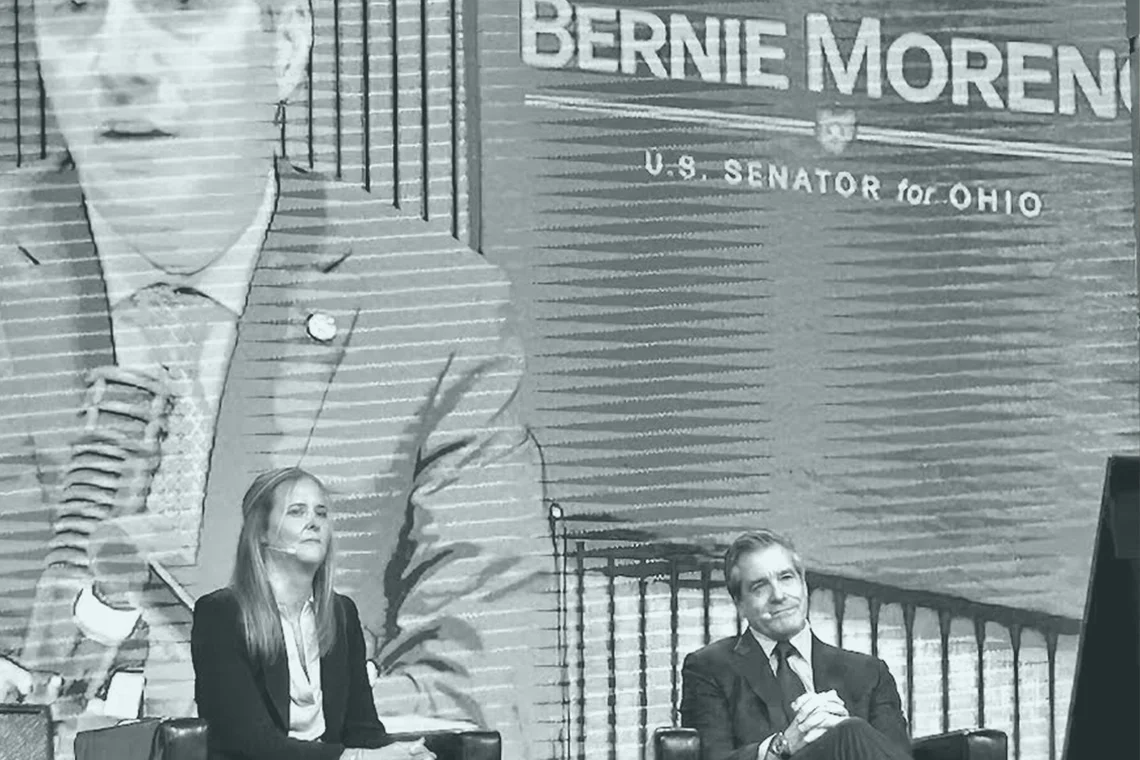
DETROIT , MI. – U.S. Sen. Bernie Moreno (R-Ohio), a former car dealer, discussed the state of the auto industry via video at the Detroit Auto Show during the press preview Jan. 16.
The Senator was joined by John Bozzella, president & CEO of the Alliance for Automotive Innovation, who attended the event in person.
Moreno was originally scheduled to be on stage with Bozzella and moderator Chrissy Taylor, but had to stay in Washington for Senate business, the press was told.
Moreno’s opening comments about the current state of the industry were positive.
“Look, we had obviously a little bit of an uncertain year, but it turned out fantastic. 2025 was the best year in the car business, and I think it’s only getting started,” Moreno said.
For example, he cited an increase in auto production coming to the U.S. and the Fed cutting interest rates, along with a provision in the One Big, Beautiful Bill Act allowing many consumers to deduct interest paid on car loans is a great thing for the industry.
“So things couldn’t be any better for the 2026,” he said.
Bozzella agreed with Moreno there are many positives in the auto industry.
“Yeah, so we ended 2025 on 16.2 billion units are a good year, a very good year, a little bit up from where we were in 2024, he said. “So it’s a resilient industry right now and the customer is in a strong position right now. If you look at projections for 2026, you know, maybe a touch below 16.2 million seems to be the consensus. So a good market, a strong market. So in that case, the sense a cost for optimism.”
However, the uncertainty of tariffs and other regulatory policy issues mean “that optimism might be tempered,” Bozzella added.
Despite the back and forth over tariffs, Moreno said its important have auto plants here in the U.S. as they provide good, high-paying jobs.
“These are not unskilled labor (jobs),” Moreno said. “In fact, people working in auto assembling plants are very, very highly trained individuals. They have a multiplier effect in communities, so not just the manufacturing facility itself, but the Tier 1, Tier 2 and Tier 3 suppliers.
“So it’s a critical industry, it makes up the most significant part of our GDP compared to any other manufacturing enterprise.”
Moreno used the example of World War II and the importance of the auto industry and its ability to pivot from domestic auto production to providing material for the war effort.
Bozzella also agreed about the need for a strong automotive industry, for similar reasons.
“A healthy and competitive auto industry in the United States is critical to our economic and our national security,” he said, pointing out the need for cutting edge, critical, high tech manufacturing skills, and capabilities, whether it’s semiconductors or supply chains.
“And so we may build dozens of worships or submarines, but we build billions of pars that demand the same technologies and the same materials.,” Bozzella said. “And so we create a mass market for the same things that the fence industry needs. That’s, I think, what Senator Moreno’s getting at.”
Moreno was asked about federal policy and how it affects the auto industry and he pointed out what he saw was the mistake of the Biden Administration in regard to EVs.
“Well, the first and most important role we play is it makes certainly create a positive environment that means good tax policy,” Moreno said. “It means a good regulatory framework so that people know what the rules are and that those guard rails are set broadly enough to allow innovation and creativity. And what we’ve learned from the last five years is what we absolutely should not do – and what we ended last year – is the government should not be weighing in and telling consumers or manufacturers what kind of cars to buy, what kind of cars to sell. that’s a vision of government setting broad guardrails rather than market outcomes.”
Bozzella offered a broader response on the relationship between government, regulators, manufacturers and consumers..
“I do think it’s important to draw this bright line between the importance of performance standards that support the industry’s investments in technologies, that give customers what they want, need, but also support for safety, fewer emissions, more mobility, less congestion,” Bozzella said. “That’s a very different government ambition and partnership with industry than having the government tell customers what they can and cannot buy. And so that’s where I draw the line. It sounds like that’s where Senator Moreno draws the line.”
Bozzella added, there has to be a balance.
“The balance between supporting innovation and competitiveness in regulations ought to be durable, they ought to be achievable, and they ought to be to some degree, somewhere to some degree and a large degree, aligned with where the consumer is.,” he said.
“Can’t get ahead of the consumer.”
He said now we’re seeing a “more realistic level of consumer demand right now without” tax incentives.