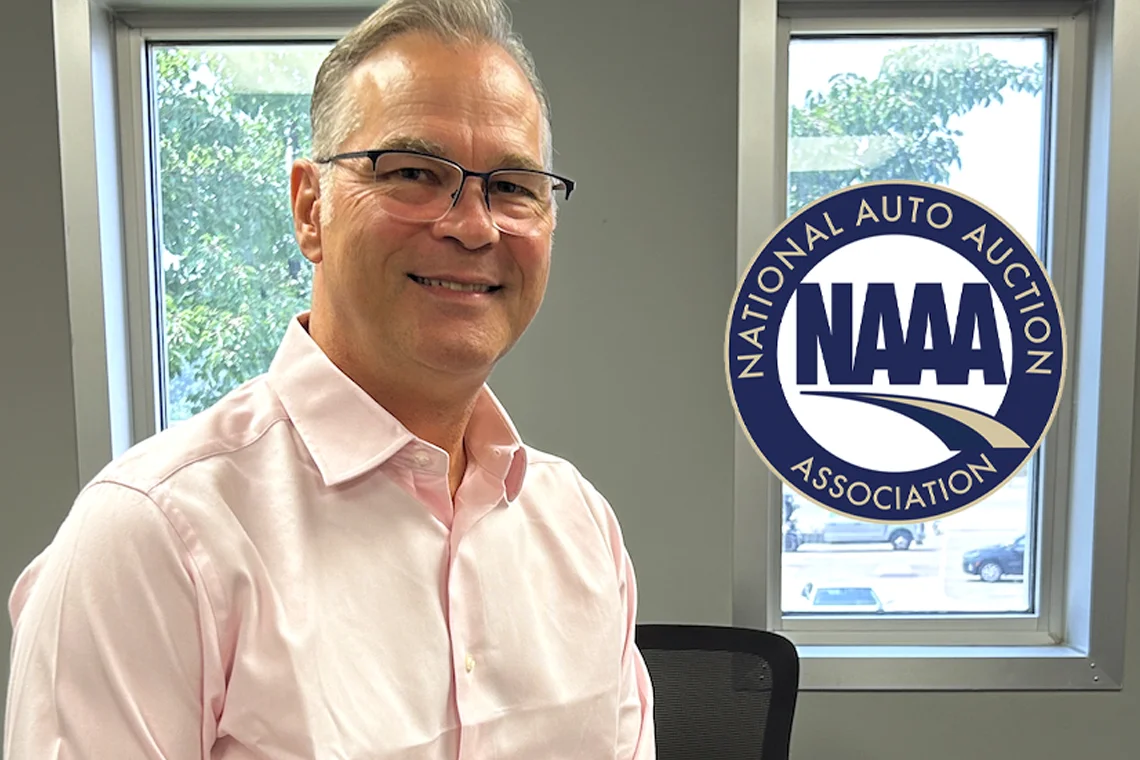
Used Car News interviewed Eddie Lafferty, general manager of Manheim Seattle, and the incoming president of the National Auto Auction Association. He will be installed this month at the 2025 NAAA World Remarketing Convention in Kansas City, Mo.
Used Car News interviewed Eddie Lafferty, general manager of Manheim Seattle, and the incoming president of the National Auto Auction Association. He will be installed this month at the 2025 NAAA World Remarketing Convention in Kansas City, Mo.
Used Car News: Tell us about your background and how you got into the auction business.
Eddie Lafferty: I’m an old car guy, but growing up, my parents owned drycleaners. Long story short, when my father passed away, my mother didn’t want to keep the businesses. I was in college at UDub (University of Washington) and she asked me to quit school to help sell the businesses. We thought it was going to take six months to sell the businesses, but they sold very quickly.
By that time, I couldn’t go back to school right away, so I didn’t have anything to do. My friend’s grandfather owned a Porsche-Audi-Volkswagen store. And he asked me if I could babysit his precious store. He said, ‘Just be nice to customers, we haven’t sold any cars in 16 months. Don’t worry about it. Just be nice to people coming in for service.’ Well, in a couple of months, I had sold him out of all of his cars.
So, I got the car salesman bug. I progressed to working in his Audi store and his Volkswagen stores for a while. He sold his stores to a larger group in 1988 or 1989. I worked for that owner for a short amount of time. Then I left and started working for another group, then went to a Honda-Acura group and worked for them for 16 years. After a change in management strategy there, I was let go. I was going to apply for a couple of jobs and this job came up for fleet-lease manager for Manheim Seattle and a GM Certified instructor. I got interviews for both, but it was Julie Picard who hired me (Manheim Seattle).
I’m incredibly grateful for everything she did for me. We became great friends and business partners. She introduced me to so many people, got me involved in the NAAA very early on in my career. That’s how I got involved in committees.
Progressively, from taking over fleet-lease, I took over some factory accounts, then GSA and then some transportation things. They now call that like a commercial manager. Then I progressed to AGM (assistant general manager) to 2013, I think. Then in 2015, I was promoted to general manager at Manheim Nevada.
UCN: What was it like going from just selling cars retail to a fleet-manager at an auto auction?
Lafferty: What’s really funny, when I interviewed with Julie Picard, she said, ‘You’ve always been in the car business, but we do things a little differently here. Let me show you what we do.’ So, Manheim Seattle has six different lots, and the body shop was farthest away. She took me there first and there were lots of cars in our inventory lot there. Then she drove me to the body shop to tell me what they do there. Then the detail shop, etc.
She asked, ‘what do you think?’ I said, ‘It looks just like a dealership, it’s just a lot more cars.’
I think the one thing that’s different is the pace. Everything is done with a higher rate of urgency. But a lot of the dealers who are consignors are dealers I grew up with in the industry. I’ve known them a long time so it feels like family and friends I’m doing business with. I grew up about 40 minutes from Seattle. For me, the transition was really easy. It felt natural and normal. For me, having that retail perspective helped amplify the understanding of customer service and why things were always so urgent for dealers. The benefits were not having to work weekends or close down a store at 8 pm. Those were the huge benefits, being closer to my family and being around as the kids were getting older.
UCN: How did you get to the point where you became GM at Manheim Seattle?
Lafferty: Julie eventually got promoted to a market vice president role and Ray Priest took over for Julie Picard. When the AGM position that reported to him moved on, I applied to that and earned that position. Ray was then running both Seattle and Portland, so I gained a lot of experience in kind of running the whole show, which is really great and one reason why I was able to move up quickly into a GM role. I was in Nevada from 2015 to 2019. We moved into a great neighborhood and made some terrific friends. I also had a really terrific team down there that we were able to develop. We grew really quickly. We benefitted from some of the traumas like the diesel vehicle recall for Volkswagen, so we had a lot of vehicles we had to manage for that. We brought in a lot of excess commercial volume that was overflooding the Riverside and Southern California markets, so they started transferring some of the cars to Nevada. We grew really quickly and well.
In 2019, they asked me to come back to Seattle as GM. It felt like a return home, closer to family.
UCN: Then COVID hit in 2020.
Lafferty: At the time, I had a daughter that was living in New York City, one that was living in Little Rock, Ark., and two kids who were still local. My daughter in NY had just had a baby and wasn’t comfortable raising kids there during COVID, so she ended up getting a job in Seattle. My other daughter, who was a TV reporter in Little Rock, got a job at the NBC affiliate back in Seattle. So the whole family came back together. Now all the kids and grandkids are at the same location, so it’s fantastic.
Being in Washington, we were the first location to close and the second to last to open back up; Puerto Rico was the only one that was after us.
We were locked down for a very long time. But we already had the tools in place at that time because chains we’re looking at ‘how can we move more digitally.’ I think the larger chains were better prepared but I won’t say that we were fully prepared. We really had to buckle down on condition reports to make sure the information was truly accurate and that what the buyer was reading is what they were getting. We had to amplify the trust in our product and our team for the buyer and consignor perspective. It made us better business people. We just had to get better at everything we did.
UCN: Tell us a little about how you began serving in the NAAA.
Lafferty: I started serving really quickly. Julie was integral in getting me involved into the association. I like to be informed about what’s going in. I like to help influence the decisions that are being made. I started out in the Education & Training committee and then the Membership Committee. The networking opportunities I made with that just helped me so much in resolving issues with clients and building my network of people. I learned so much through other people and the conventions. I had resources that I could reach out to after that who were so valuable. I wanted to continue and get other people involved. That’s why I stayed active in the association as long as I have.

Manheim Seattle Team.
UCN: Did you ever picture yourself in this position as NAAA President?
Lafferty: I really didn’t. It’s such an honor and so humbling to even be considered or nominated for it. When they called me and said I’d been nominated, I said, ‘Me?’
Then to have been elected, I’m just so overwhelmed. I joke with new President-elect Tommy Rogers (who will become the president for 2026-2027) when you get in these positions and you start to hear these nice things that people say about you, gosh, do I put these on a resume or on my epitaph? The best part of this whole process is being able to travel with (incoming Chairman) Craig Amelung and Tommy, just people who are truly passionate about the industry and wanting to make (members) feel supported. I’ve learned so much traveling with these guys.
Also, I’ve gotten the chance to take off the brand hat and just work as an ambassador for the industry, getting to visit independent auctions. Just going into another auction, watching how passionate they are and watching their interactions with the customers. It’s also exciting to watch how they’ve adapted to the changes and I get tips and tricks, best practices I can take back to my team and implement them. I get to see fun ways to make sure we’re serving our customers well or marketing correctly. It’s just been a huge opportunity and I’m so grateful.
UCN: Tell us about some of the industry folks that you’ve met and learned from along the way.
Lafferty: I have been so incredible blessed throughout the industry. It started when I was in retail, with the owners who trusted me with various roles within their dealerships. I was able to take some of that knowledge and kind of apply what I learned – my strategies, vision – to what I did in the auction business. But Julie Picard was probably the most prominent mentor I ever had. She introduced me to so many people. It was amazing. Ray Priest is the one who taught me the operations side of the business, like looking at data, reporting and the tools that you use. That was fantastic. I owe him a lot. He’s a terrific friend and we still speak frequently. We love to practical-joke each other. There are countless others, like Scott Hurst was the one who hired me for GM in Las Vegas. He used to be market vice president in Southern California. He was a terrific mentor, as well. But it’s impossible to name all of the people I’m grateful for.
UCN: What are the biggest ways you’ve seen the industry change since you got into the business?
Lafferty: I’ve been in the business for 41 years. I think COVID was the biggest change and had the largest impact that I’ve ever seen. I mean, there was the housing collapse from 2008-2010 and we thought, how are we ever going to recover from this and we made it through. Then COVID hit and it forced us on to support people in a really different way, going from these physical sales into these digital sales. I think we’re still feeling the effects of that and we will forever. Maintaining the trust and relationships is much more difficult now because most of them are digital transactions. I haven’t seen the return of the buyer into the physical lanes the way some other auctions have. We were predominantly a commercial sale, 75/25 commercial to dealer. Now we’re about 75/25 dealer. We used to have 800 to 1,100 people who would be in the lanes and there would be, maybe, 150 people online. That number completely flipped.
Generationally, I think people are becoming more technically savvy, comfortable with it. They don’t have a choice. And some locations, like us being in Seattle, the traffic and growth have been tremendous, so getting to the auction isn’t as easy anymore. For some it’s an hour-and-a-half to get to the auction and an hour-and-a-half back home. Using digital tools has made it easier.
I think we’re on the cusp of the next change, which is probably AI and how that helps us manage and run our business and how to protect ourselves from fraud.
UCN: What are some of the challenges today?
Lafferty: Obviously, how the tariffs are impacting the local economies and the pricing of cars. But there’s been some waffling and where those numbers come in for a landing price. It’s going to elevate the price of new vehicles. Interest rates have not dropped (at press time). We don’t see some of the incentives that we used to see. Supply is still going to be an issue. It’s going to create more demand for used vehicles, especially the late model used vehicles.
It's going to be a challenge for a while. I think the biggest thing coming forward is to be ready for the onslaught of off-lease electric vehicles coming back. Traditional ICE cars bring somewhere around a 60% retention value where EVs are about 40%. Those might be the lower priced vehicles that can help people transition to an EV economy. We’ll see. (Cox) has a lot of investment into handling these vehicles, infrastructure, charging stations, (studying) battery life of EVs, etc.
UCN: Talk about the goals you have for your presidency, though it does seem to be a relay race as one president passes off to the next.
Lafferty: I think that’s really a great analogy. I think it really is a relay race. I think it began even before 2023-2024. NAAA President Eric Autenrieth and Craig have done such a great job fundamentally helping to strengthen the association, whether it’s working on bylaws or reinforcing the need for the chapters to be more engaged and involved for us to drive content back to the larger events that we need.
It's making sure we help the association adapt to the changes in the industry, whether it’s EVs, education and training, defending cyber security – those things are still important. But really, it’s about strengthening the association, trying to drive some of the participation deeper into the auctions – instead of just the GMs looking at education and training – trying to get to those other auction employees who are using it day to day with their customers.
That’s a big initiative for me, trying to drive that participation down deeper into the auctions.
We really need everyone’s voice. Everyone does matter in this. We need participation so that we make sure that everyone is being heard. Without input from everybody, then we’re not serving everybody.
*This article is an extended version of the interview which appears in UCN's 9/15 online and print edition.