
A New York BMW dealer says its retail labor clock should determine warranty reimbursement.
When Wide World BMW notified BMW of North America that it planned to use its retail labor-time methodology for warranty work, the New York dealership probably expected a fight over paperwork.
Instead, the disagreement has landed in federal court.
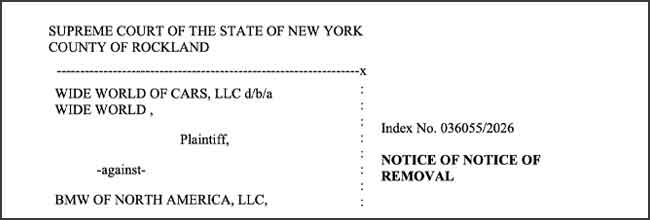
The Spring Valley BMW store filed suit against BMW over how warranty, recall and diagnostic labor should be calculated. The case centers on a 2024 change to New York's franchised dealer law that ties warranty labor reimbursement to the retail labor-time guide reasonably used by a dealer for customer-pay work.
BMW removed the lawsuit to federal court on Sept. 9, where the case is now pending in the U.S. District Court for the Eastern District of New York.
The dispute puts two very different clocks against each other: the labor time Wide World says it uses in its retail operation and the warranty time BMW says should apply. And that difference is where the money is.
Wide World BMW is part of New Country Motor Car Group, a dealership organization built by Michael Cantanucci and now led by his son, Jared Cantanucci.
New Country operates dealerships across six states, representing brands including BMW, Audi, Ferrari, Lexus, Maserati, Mercedes-Benz, MINI, Porsche and Toyota. The group currently lists four BMW operations: Wide World BMW in Spring Valley, New Country BMW in Hartford, BMW of Alexandria in Virginia and BMW of the Main Line in Pennsylvania. At Wide World BMW, Brian Sorce serves as general manager. The Spring Valley operation includes new and used vehicle sales, finance, parts, service and collision operations.

That makes the dispute particularly relevant to the dealership itself. This isn't an abstract argument over how a warranty claim should be coded. It involves the labor-time methodology being used inside a working BMW service department.
New York amended its franchised dealer law in 2024 to address how dealers are compensated for warranty, recall and diagnostic work. The law provides a framework under which warranty labor compensation is tied to the retail labor-time guide reasonably used by the dealer for non-warranty customer-pay work.
Wide World says it followed that process.
According to the complaint, the dealership uses CDK's Service Pricing System for customer-pay work. Wide World notified BMW that it intended to use CDK's retail labor-time allowances when calculating manufacturer reimbursement. The dealership submitted more than 20 sequential retail repair orders from the preceding 90 days to support its use of the system and declared a 1.88 multiplier.
BMW rejected the methodology. According to Wide World's complaint, BMW told the dealership that CDK Service Pricing was a pricing methodology rather than a qualifying labor-time guide. BMW directed Wide World toward BMW's own warranty labor guide or third-party guides such as Chilton, ALLDATA or Mitchell.
Wide World argues that BMW's position effectively leaves the automaker in control of the very labor-time standard New York's amended law was intended to address.
The dealership alleges the disagreement has affected warranty, recall and diagnostic repairs dating back to November 2024. The complaint also alleges BMW required prior approval of the labor guide, required an “industry recognized” guide, used an Opt In/Opt Out form and withheld instructions needed to submit claims under Wide World's declared methodology.
BMW has disputed the dealership's interpretation. The court has not ruled on the merits.
The difference between two labor-time guides can become significant when multiplied across a dealership's warranty workload. Wide World argues that the retail labor times it uses with customer-pay customers should carry into its manufacturer-reimbursed work. BMW's position, according to the complaint, is that the CDK system doesn't satisfy the statutory definition of a qualifying labor-time guide.
That leaves the court with a very specific question: when New York law connects warranty reimbursement to a dealer's retail labor practices, how much discretion does the manufacturer retain over the labor-time standard?
The answer could determine whether Wide World's declared methodology can be used for BMW warranty claims.
Wide World's lawsuit arrives as several states have changed the traditional approach to warranty labor reimbursement.
Minnesota changed its law to require warranty labor compensation to be based on the time guide a dealer uses for customer-pay work. The Minnesota Automobile Dealers Association subsequently sued Volkswagen over the automaker's handling of the new reimbursement requirements. The case remains unresolved, although a federal court has allowed Volkswagen to seek information about the time guides dealers actually use in their retail operations.
Illinois has produced a more recent dealer-side ruling. Illinois law establishes minimum warranty compensation requirements and limits manufacturers' ability to recover those additional costs from dealers. Volkswagen responded with a surcharge program aimed at recovering higher warranty expenses associated with the state's law. Thirty-three Volkswagen and Audi dealers challenged the surcharge before the Illinois Motor Vehicle Review Board.
In August, the board ruled against Volkswagen's surcharge program.
 The state laws aren't identical, but they reflect a growing legislative fight over the traditional manufacturer-controlled warranty clock. New York, Minnesota, Illinois, Montana and Alaska are among the states that have adopted provisions giving dealer retail labor practices or third-party time guides a role in warranty reimbursement.
Wide World is seeking at least $75,000, along with additional damages, interest, attorney's fees and costs. The complaint alleges BMW's approach has resulted in reimbursement below what Wide World says it is entitled to receive under New York law.
Those allegations have not been proven, and BMW has disputed the dealer's position.
For Wide World and New Country, the case now becomes a question of how New York's revised franchise law actually works when a manufacturer and dealer disagree over the labor-time guide.
For other dealers watching the case, the question is easy to understand:
Who controls the warranty clock?