
Critical Shifts:
-
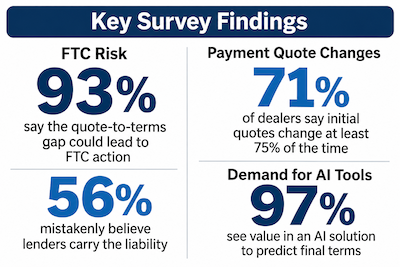
Hidden Regulatory Liability for Dealers: When initial monthly payment quotes change after lender approval, the dealership—not the lender—is legally liable for the discrepancy, yet 56% of dealers mistakenly believe lenders carry that risk, even as 93% recognize the gap could trigger FTC enforcement.
-
AI Lending Models Are Driving Guesswork: As auto lenders replace standard rate sheets with proprietary "black-box" AI underwriting, dealers are forced to guess initial payment terms, resulting in average underquotes of roughly $2,240 over the loan term and payment changes at least 75% of the time.
-
Strong Demand for Upfront Predictive Tools: To prevent deal re-writes, lost sales, and compliance exposure, 97% of industry respondents say dealerships need AI-powered prequalification tools at the start of the sales process to accurately predict fundable contract terms early.
___________________________________
A growing gap between the monthly payments quoted to car buyers and the final financing terms approved by lenders could be creating compliance risks for dealerships, according to a new industry survey.
The survey, conducted by 700Credit and eLEND Solutions, found that 93% of dealer respondents believe discrepancies between initial payment quotes and final loan terms could lead to Federal Trade Commission (FTC) enforcement. However, 56% incorrectly believe lenders, rather than dealerships, carry the liability for those differences.
The findings point to a financing challenge that has become more complicated as lenders move away from traditional rate sheets and increasingly rely on proprietary underwriting models to determine loan terms.
According to the survey, 92% of respondents said the reduction in standard lender rate bulletins contributes to the gap between initial dealer quotes and final fundable contract terms.
Without those rate sheets, dealerships have less information available to estimate financing terms before submitting a customer's application. As a result, payment quotes can change substantially after a lender reviews and approves the deal.
Among dealer respondents, 71% said initial quotes—including monthly payment, down payment and loan term—change at least 75% of the time following lender approval. Across all respondents, the figure was 56%.
The resulting adjustments can force dealerships to rewrite deals, reopen financing discussions with customers or potentially lose sales. The survey estimated that inaccurate initial quotes can result in average underquotes of approximately $2,240 over the life of a loan.
AI underwriting adds uncertainty
The shift toward automated lending decisions is another factor identified in the survey.
While 70% of lender respondents said the move to black-box decisioning is the biggest reason traditional rate sheets have disappeared, 51% of all respondents identified it as the primary factor.
These proprietary models can make it more difficult for dealerships to predict the terms a lender will ultimately approve, particularly when initial payment estimates are made before the lender completes its underwriting process.
The survey also found that 75% of respondents see potential value in AI and machine learning for improving dealership intelligence, provided the technology is supported by accurate and complete information.
Dealers want financing answers earlier
 Despite concerns about the growing complexity of lender decisioning, respondents showed strong support for tools that could help dealerships establish more accurate financing expectations earlier in the sales process.
Nearly all respondents—97%—said an AI-powered solution capable of predicting fundable contract terms at the beginning of a sale would be valuable to dealerships. More than three-quarters, or 77%, described such a solution as extremely valuable.
Time savings were identified as one potential benefit by 46% of respondents. Other anticipated benefits included fewer customer disruptions during financing, less friction during deal completion and improved front-end and back-end profitability.
“These results are a wake-up call for our industry,” said Pete MacInnis, founder and CEO of eLEND Solutions. He said the mismatch between lender terms and dealer quotes creates risks beyond regulatory scrutiny, including customer satisfaction and dealership profitability.
Ken Hill, managing director of 700Credit, said predictive financing intelligence could help dealers begin the sales process with more reliable information.
The online survey was conducted in October 2026 and included 150 self-identified auto dealers, lenders and allied industry professionals across the United States.