Critical Shifts:
-
Commercial focus for impact: Honda and other industry leaders are prioritizing heavy commercial and logistics vehicles for dynamic charging, aiming to minimize downtime and reduce battery size rather than targeting passenger cars first.
-
Rigorous durability testing: Honda is testing its system against high-capacity power outputs up to 150 kW and subjecting the pavement-embedded equipment to intense stresses, including up to 1 million wheel loads to prove roadworthiness.
-
Global transition to active roads: Dynamic wireless charging is moving from laboratory trials to real-world infrastructure, backed by active public road deployments in Detroit and planned expressway demonstrations in Japan for 2027.
_________________________________
Honda is preparing to test wireless technology that could charge electric vehicles while they are moving, building on road-charging projects already being tested in the U.S. and Europe.
Honda is taking another step toward charging EVs while they drive.
Honda R&D, working with Taisei Corp. and Taisei Rotec Corp., says it has developed the underlying technology for a wireless charging road that can transfer power to an EV through equipment embedded in the pavement. The companies have already tested the system on a private test road and plan additional testing later this year.
The next round will test whether the system can withstand the punishment of actual road use, including a durability test equivalent to 1 million wheel loads. The companies also plan to test wireless power transfer at outputs of up to 150 kilowatts, with large commercial EVs specifically in mind. High-speed operation and electromagnetic-field leakage will also be evaluated.
Honda and its partners are targeting a public-road demonstration in Japan beginning in fiscal 2027, which starts April 1, 2027. The demonstration is planned as part of the Tateyama Project on the Tateyama Expressway in Chiba.
Honda isn't the first
The idea of charging a vehicle while it drives has already moved beyond the laboratory.
Sweden has tested several versions of electric-road technology. The Smartroad Gotland project used inductive wireless charging on a 1.6-kilometer section of road, including testing with an electric truck. Another Swedish project in Lund used an electrified rail embedded in the road, with a vehicle-mounted collector making physical contact with the rail. Those Swedish technology tests have now ended.
The U.S. has gone further as well.
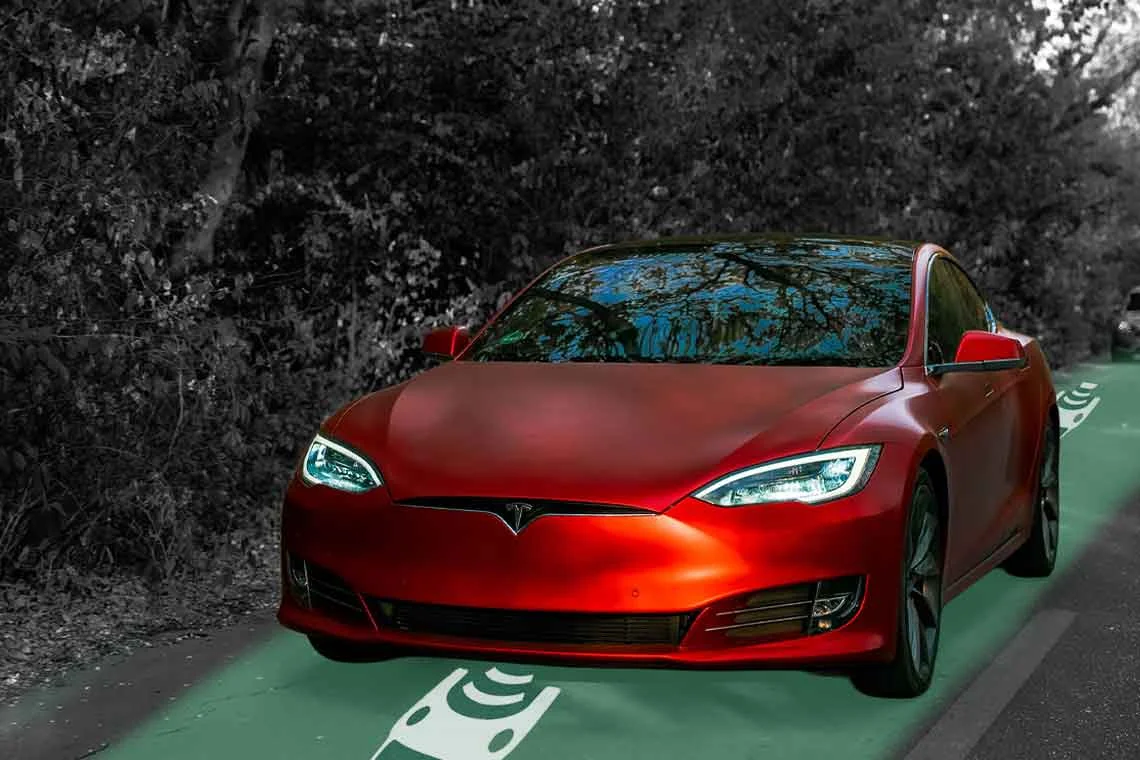
In Detroit, Michigan, a quarter-mile section of 14th Street near Michigan Central became operational in 2023 as the nation's first public wireless EV-charging roadway. The system, developed by Electreon and supported by the Michigan Department of Transportation, uses inductive coils beneath the pavement to charge equipped vehicles while they are moving or stopped.
The Detroit project isn't sitting still. Michigan has contracted with Electreon for a $6.5 million POWERDRIVE wireless EV-charging network project in Detroit. The contract runs through the end of 2027 and includes planning, design, vehicle integration, construction and testing.
Michigan has also been looking beyond the original 14th Street installation. A separate project has called for wireless charging to be incorporated into a section of Michigan Avenue in Corktown during a future road reconstruction project.
The bigger test is heavy vehicles
That's where Honda's announcement gets more interesting.
Honda says its initial goal is to put dynamic wireless charging to work in logistics and transportation, rather than starting with ordinary passenger vehicles. Keeping a commercial EV charged while it is working could reduce charging stops and potentially allow vehicles to carry smaller batteries.
That same idea is being explored in Detroit. Electreon says its Detroit work has expanded to include a wireless-charging project involving UPS and an Xos electric stepvan, extending the experiment from a demonstration vehicle to commercial delivery operations.
The technology still has some big questions to answer. Building charging equipment into roads is considerably different from installing a conventional charging station. The systems have to survive traffic, road repairs, weather and heavy vehicles while delivering enough electricity to make the investment worthwhile.
Honda itself has not yet said what its system would cost compared with conventional fast-charging infrastructure.
For now, the important development is that several projects are moving the concept through different stages: Sweden has tested electric roads, Detroit has an operating public wireless-charging roadway, Michigan is funding additional deployment and commercial-vehicle testing, and Honda is preparing to take its own wireless system toward public-road testing in Japan.
For EVs, the long-term idea is a shift from stopping to charge to charging as part of the trip itself. Whether that becomes economical on a large scale is the part the industry is still trying to prove.