
Used-car inventory risk is becoming less about how long a vehicle sits and more about whether its price, value and market demand remain aligned.
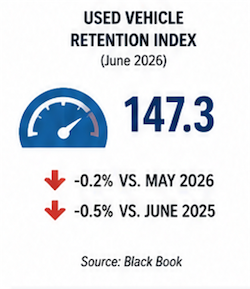
For years, used-car inventory risk has been measured largely by time. A vehicle sits for 30 days, then 45, then 60, and as the days accumulate it becomes a problem that needs to be solved. But the used-car market in 2026 is making that equation less straightforward. Black Book’s latest data shows used-vehicle values continuing to normalize, with its Used Vehicle Retention Index at 147.3 in June, down slightly from May and 0.5% from a year earlier. The relatively modest movement in the overall index, however, masks a market where individual vehicles can behave very differently. Buyers don't shop an index. They shop a specific vehicle, at a specific price, with a specific history and payment. Increasingly, those factors may tell dealers more about inventory risk than the number of days a vehicle has been sitting on the lot.
The Trade-In May Be the First Warning
The issue becomes even more complicated when financing is involved. A vehicle can arrive at a dealership with a payoff that has little relationship to what the vehicle is worth in the wholesale market. The trade itself may make sense as part of a larger transaction, but once the vehicle becomes inventory, it has to compete with every other vehicle available to the next buyer. That is where an apparently attractive acquisition can become a risk.
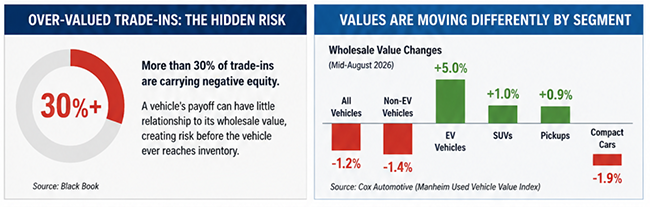
Black Book says more than 30% of trade-ins are carrying negative equity, a condition that can make affordability worse and complicate the transaction before the acquired vehicle even becomes inventory. “More than 30% of trade-ins are carrying negative equity, and that has implications across the entire used market,” Black Book said.
The important distinction isn't simply whether a dealer “overpaid” for a trade. It is whether the price paid to acquire the vehicle remains connected to what today's used-car buyer believes the vehicle is worth..
Buyers Don't See Inventory the Way Dealers Do
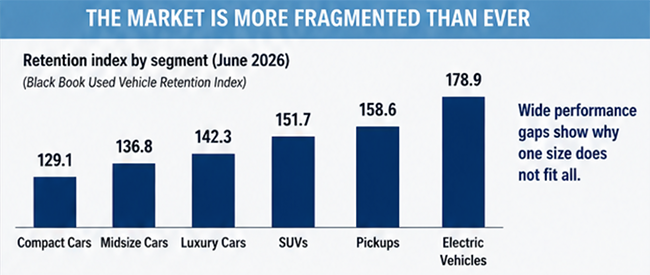
Current market data shows how fragmented the used market has become. Cox Automotive reported July average used-vehicle listing prices at $27,028, while vehicles priced below $15,000 had just 32.2 days of supply, compared with 46 days overall. That gap illustrates how differently inventory can behave depending on price point. Lower-priced vehicles remain relatively scarce, while higher-priced inventory can face a different set of affordability and competitive pressures.
Black Book's June analysis also underscored the differences between vehicle segments, noting that “Market performance varied across segments.” The company pointed to increased new-vehicle incentives putting pressure on some late-model used vehicles, particularly where new inventory was becoming more competitive. In other words, a used vehicle isn't competing only against other used vehicles. In some cases, it is also competing against a new vehicle whose price has become more attractive.
At the same time, wholesale values are moving differently across vehicle types. Electric vehicles, for example, have recently behaved differently from the broader non-EV market. That means “used cars” increasingly describes a collection of markets rather than one market. The buyer shopping for a $20,000 compact car isn't necessarily responding to the same factors as the buyer shopping for a $35,000 three-row SUV.
Age Is Easy to Measure. Risk Is Harder
Days in inventory are attractive as a management metric because they are simple. Risk is more complicated. Consider two vehicles that have both been on a lot for 45 days. One may have limited local competition, a clean history and a price that remains attractive compared with similar vehicles. The other may have dozens of comparable listings, a history-adjusted value that makes it less competitive and a retail price that hasn't kept pace with the market. Both are 45 days old, but they don't necessarily represent the same level of risk.
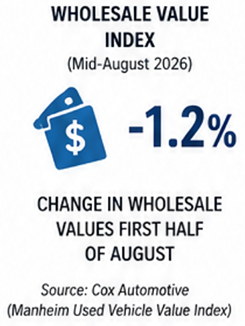 Black Book's valuation data increasingly points toward this kind of differentiation. Vehicle history, condition and market demand can create meaningful differences in what otherwise appear to be comparable vehicles. A vehicle's risk can change even when its odometer and inventory clock don't. Wholesale values can move, new-car incentives can change the competitive landscape, additional supply can enter a market or shoppers can shift their preferences to another type of vehicle.
That raises a different question about aging inventory: not simply how long a vehicle has been sitting, but what has happened to its position in the market while it has been sitting.
The Buyer Ultimately Sets the Value
Wholesale data establishes one side of the equation. Retail shoppers establish the other. The difference between acquisition cost and retail selling price is where the potential gross exists, but that spread only exists if the retail market accepts the vehicle at the expected price. Buyer behavior therefore becomes an important part of understanding inventory risk.
Affordability is one of the clearest examples. Used-vehicle prices remain well below new-vehicle prices, but monthly payments have become a critical part of the purchase decision as interest rates, vehicle prices and loan terms interact. Negative equity can further restrict what a shopper can realistically purchase. A vehicle can be desirable in theory and still be difficult to sell at a particular price if the resulting payment falls outside the buyer's budget.
The same is true of vehicle selection. A shopper may prefer a particular model, but if several similar vehicles are available nearby at lower prices, the competitive set changes the vehicle's effective market value. The vehicle hasn't changed; the market around it has. Consumers can compare thousands of listings without ever visiting a dealership, making price, mileage, equipment, history and location part of an increasingly transparent comparison.
Inventory Risk Is Becoming More Individual
The used-car market has always had winners and losers. What appears to be changing is the degree to which those differences matter. Black Book's retention data, wholesale auction results and retail listing data all point toward a market where broad averages can obscure significant differences between individual vehicles and segments.
That makes the traditional age-based view of inventory increasingly incomplete. A vehicle doesn't suddenly become undesirable on its 61st day, just as it doesn't remain a safe investment simply because it is relatively new. Its risk can change when wholesale values move, when competing inventory arrives, when a manufacturer changes incentives on new vehicles, when financing conditions change or when shoppers begin favoring another type of vehicle.
In that environment, inventory risk is less about the calendar than the relationship between what a vehicle cost, what the market says it is worth and what buyers are willing to pay. That relationship also helps explain why an over-valued trade-in can become a more significant problem than an older vehicle that remains highly competitive in its market.
For independent dealers, that may be one of the more important developments in today's used-car market. The question surrounding a vehicle isn't simply how long it has been on the lot. It is whether the vehicle is still aligned with the market and with the buyer who is looking for it.