
Critical Shifts:
-
Auto Market Resilience Amid Economic Headwinds: Despite macroeconomic concerns like inflation, high interest rates, and tariffs, vehicle sales remain remarkably steady as aging cars eventually require replacement.
-
Consumer Demand Shifts Toward Low-Cost Used Vehicles: Affordability pressures are driving buyers toward older, cheaper used vehicles (particularly in the $15,000–$18,000 range), creating strong demand and competition for independent dealers offering aged inventory.
-
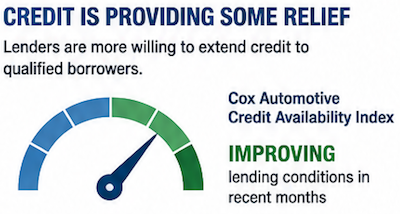
Financing Accessibility and Dealer Strategy: Lenders are increasingly willing to extend credit to qualified borrowers to help move inventory, while Cox Automotive recommends dealers focus on local lot traffic and weekly wholesale/retail metrics rather than broad national economic headlines.
_________________________________________________________________
Tariffs, interest rates, fuel costs, inflation and a $40 trillion national debt have given consumers plenty of reasons to be cautious. Yet the automotive market continues to show a more complicated picture.
Cox Automotive Chief Economist Jeremy Robb sees a market that has remained relatively stable despite the economic uncertainty. At the same time, the latest data from Black Book shows wholesale prices continuing to decline, with truck and SUV values under particular pressure. Taken together, the two views suggest the market is not falling apart—but it is becoming more selective.
New-vehicle sales have remained relatively steady, while demand for older, more affordable used vehicles has strengthened. Consumers may delay replacing a vehicle, but eventually an aging vehicle needs to be replaced, particularly as repair and maintenance costs rise.
Robb said affordability is increasingly shaping what consumers buy.
“Consumers are looking for something affordable. If they can get their hands on a $15,000 or $18,000 car, there’s more competition in that marketplace.”
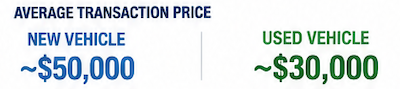
The affordability equation extends beyond the purchase price. Insurance, fuel, repairs, maintenance and financing all influence what a buyer can realistically afford. With the average new-vehicle transaction price still near $50,000 and the average used vehicle around $30,000, older used vehicles can become an increasingly important alternative.Financial pressure can change what consumers buy without eliminating the need to buy.
The shift is particularly significant at the lower end of the used-vehicle market. As monthly payments on newer vehicles become harder for some households to absorb, buyers are increasingly looking at older vehicles as a way to stay within a manageable total cost of ownership. That puts vehicles in the $15,000 to $18,000 range in a particularly interesting position. Rather than representing the bottom of the market, these vehicles can become the practical target for shoppers who still need transportation but cannot justify—or qualify for—the cost of a $25,000 or $30,000 used vehicle. Robb's observation that there is “more competition” for these cars points to an important opportunity for independent dealers: affordability is creating demand for aged inventory, but it is also creating competition for the vehicles that can meet that demand. In a market where consumers are increasingly shopping by payment and overall ownership cost, an older vehicle with the right price, condition and reliability can have more retail appeal than a newer vehicle carrying a significantly higher price tag
Wholesale Is Telling a Different Story
While retail demand remains relatively resilient, Black Book's latest wholesale data shows that values are under increasing pressure. For the week ending Aug. 22, overall wholesale depreciation accelerated to -0.52%, compared with -0.49% the previous week and more than twice the 2017–2019 same-week average of -0.21%.
Trucks and SUVs experienced the greatest pressure, declining -0.58%, while cars declined -0.35%. The weakness was broad. All 13 truck segments declined, while every reported car segment between two and eight years old and eight and 16 years old also posted declines. Compact Crossover/SUV values have now declined for 12 consecutive weeks, averaging a 0.44% weekly decline. Last week, that depreciation accelerated to -0.80%.
The auction market tells a similar story. The auction conversion rate improved to 59%, up two percentage points from the previous week, but wholesale values continued to fall. Black Book noted that buyers remain selective, placing greater emphasis on condition, equipment, configuration and retail appeal. That is an important distinction. Vehicles are still selling, but not every vehicle is being valued the same way.
Inventory Is Becoming More Important
Black Book estimates used-retail days-to-turn at roughly 34 days, while wholesale markets remain under pressure. That combination creates a different kind of challenge for dealers. A vehicle may have consumer demand, but its value can still move against the dealer between acquisition and retail sale.
For independent dealers, that makes the relationship between acquisition cost, wholesale value and retail demand increasingly important. The market is rewarding vehicles that fit what shoppers can afford and penalizing inventory that does not. Robb's advice is to watch the market rather than relying solely on national economic headlines.
“Pay attention to traffic, pay attention to sales trends. For me, I watch the wholesale market and I watch the retail market every week.”
Those two markets are telling different parts of the same story.
Retail demand remains resilient because consumers still need transportation and many are shifting toward more affordable vehicles. Wholesale prices, meanwhile, are declining because buyers are becoming more selective and certain segments have more pricing pressure than others.
Bottom Line
The automotive market is neither as strong nor as weak as the headlines might suggest. Cox Automotive's view shows a consumer market that continues to function despite economic pressure. Black Book's wholesale data shows that dealers cannot assume that resilience will protect every piece of inventory.
For independent dealers, the opportunity may be in the gap between those two realities. Consumers are still looking for affordable transportation. But wholesale buyers are becoming more selective, and vehicle values continue to move unevenly across segments.
The market may still have buyers. The challenge is having the right inventory at the right cost.
That makes local traffic, retail demand, wholesale trends and individual vehicle characteristics more important than broad economic headlines. The economy may be sending mixed signals—but the lot is giving dealers a much more immediate read on what is actually working.